Sentinels
An Exploration of Colorado’s Eastern Plains
Colorado is most often associated with the Rocky Mountains—the dramatic skyline of fourteen thousand foot peaks that draws millions of visitors each year. Travelers arrive in Denver, explore the Front Range, and continue west toward the mountains. The state's identity is inseparable from these iconic landscapes.
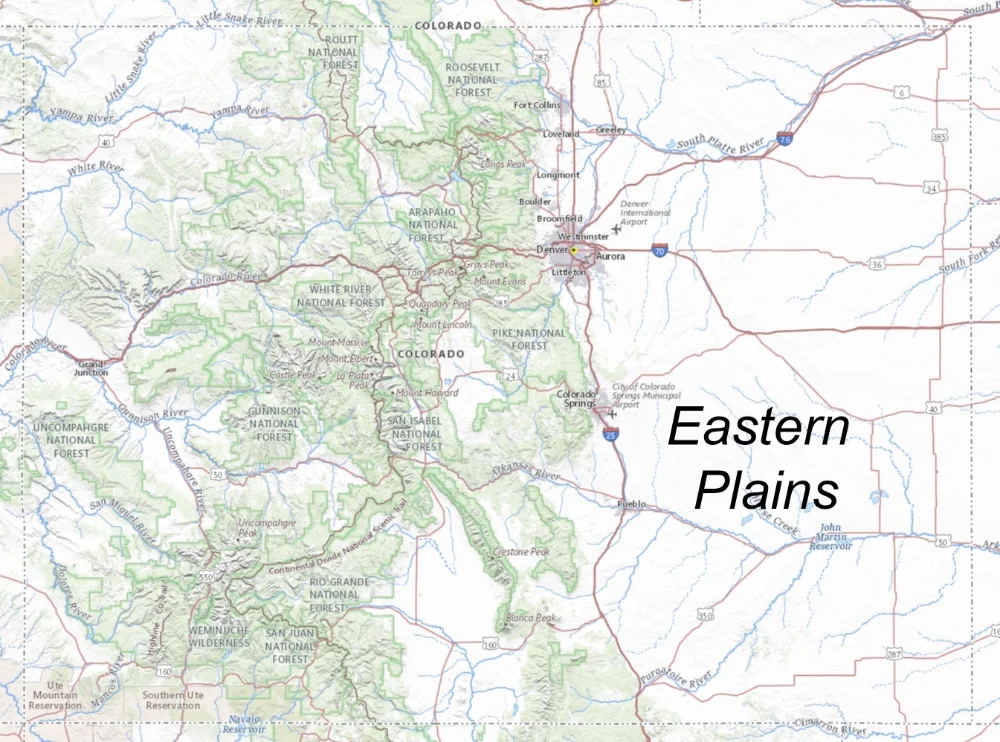
Yet nearly one-third of Colorado lies east of Denver, stretching across the Eastern Plains, the western edge of the American High Plains. This vast landscape of grassland, grain, and cattle is sparsely populated and often overlooked.
The Eastern Plains are defined by distance and scale. Fields of wheat, corn, and sorghum extend to the horizon. Livestock outnumber people. Small towns are separated by dozens of miles, connected by highways, rail lines, and a shared dependence on agriculture. Here, the rhythms of life are tied to weather, harvests, and commodity prices. As farming practices evolve, markets consolidate, technology advances, and climate patterns shift, many communities face an uncertain future.
Sentinels is a five year photographic exploration of Colorado's Eastern Plains, centered on the structures that dominate both the landscape and the imagination of the region: grain elevators and storage silos.
In a geography where the land is almost perfectly level, these structures become landmarks. Rising above fields and towns, they are visible from miles away. For travelers crossing the plains, the first indication of a community is often the sight of a grain elevator emerging from the horizon.
Functional by design, these structures serve as storage facilities and transfer points in the movement of grain from farm to market. Yet they are also monuments to the agricultural economy that shaped the region.
Metaphorically, these structures are guardians and witnesses. They stand watch over the land, observing decades of change. They have witnessed droughts, prosperity, and hardship. Their forms dominate the skyline not only physically, but culturally, serving as reminders of the labor, ingenuity, and determination required to make a living in this demanding landscape.
The same story can be found beyond the grain elevators. The dry climate and high elevation have preserved abandoned homesteads, schools, churches, barns, and agricultural buildings throughout the plains. These structures bear witness to the ambitions of early settlers who arrived with hopes of prosperity and permanence.
This project examines these structures not only as industrial infrastructure, but as enduring symbols of the Eastern Plains—silent sentinels watching over a landscape that remains essential to Colorado, even as it is frequently overlooked by those passing through the state.
My goal is to document the geography of the region, to convey a sense of place, and to explore the relationship between the natural landscape and the marks left upon it by human ambition. The photographs seek to place individual structures within the broader context of the plains themselves, revealing how people have adapted to an environment defined by distance, wind, weather, and scale.
The beauty of the Eastern Plains is not dramatic in the way of mountain landscapes. It emerges from vastness and subtlety. The horizon seems endless. Light travels across open ground uninterrupted for miles. Weather becomes spectacle. Clouds cast shadows that stretch across entire counties, and skies grow so immense that they often dominate the view. Within that expanse, grain elevators, abandoned buildings, and small towns become points of reference—human gestures set against a landscape that is far larger and older than themselves.
Sentinels is an effort to record those gestures and the stories they embody before they disappear, while celebrating the resilience, history, and enduring character of Colorado's Eastern Plains.


Sentinels2